
You Helped Build This
Now Watch It Burn

The outdoor industry endorsed Doug Burgum. Doug Burgum just cut the National Park Service’s maintenance budget by 40 percent. Enjoy your seat at the table.
Interior Secretary Doug Burgum defended the Trump administration’s FY2027 budget before the Senate Energy and Natural Resources Committee. It proposes a 40 percent cut to the National Park Service's maintenance budget while requesting $10 billion for a new “Presidential Capital Stewardship Program” to fund construction and beautification projects around Washington, D.C.
Ten billion dollars has been allocated for projects near the president’s residence. Forty percent less funding is available for parks used by the wider public.
Before directing all the outrage at Burgum, it’s worth reflecting on the outdoor industry’s own role. Some of its members supported his ascent.
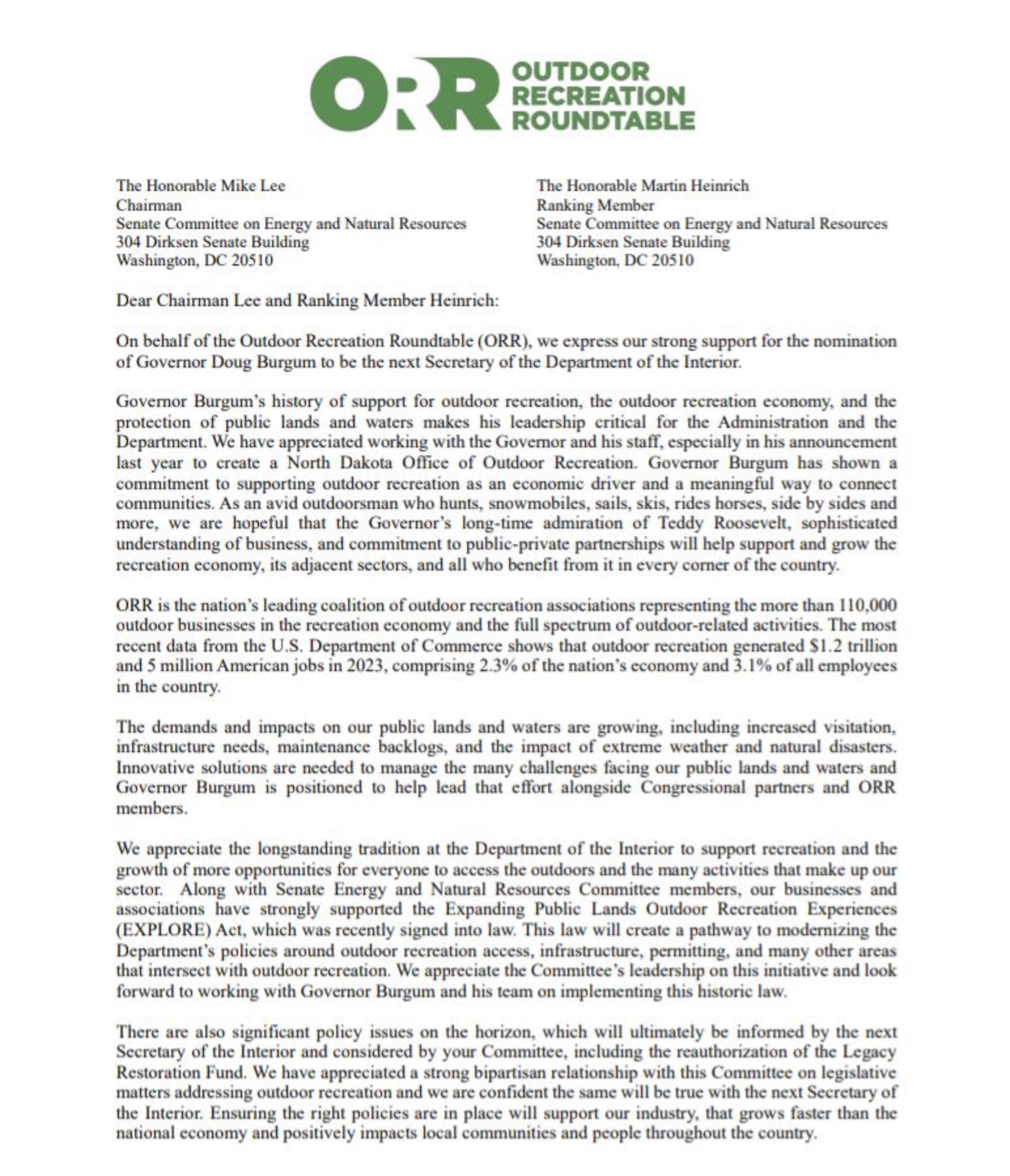
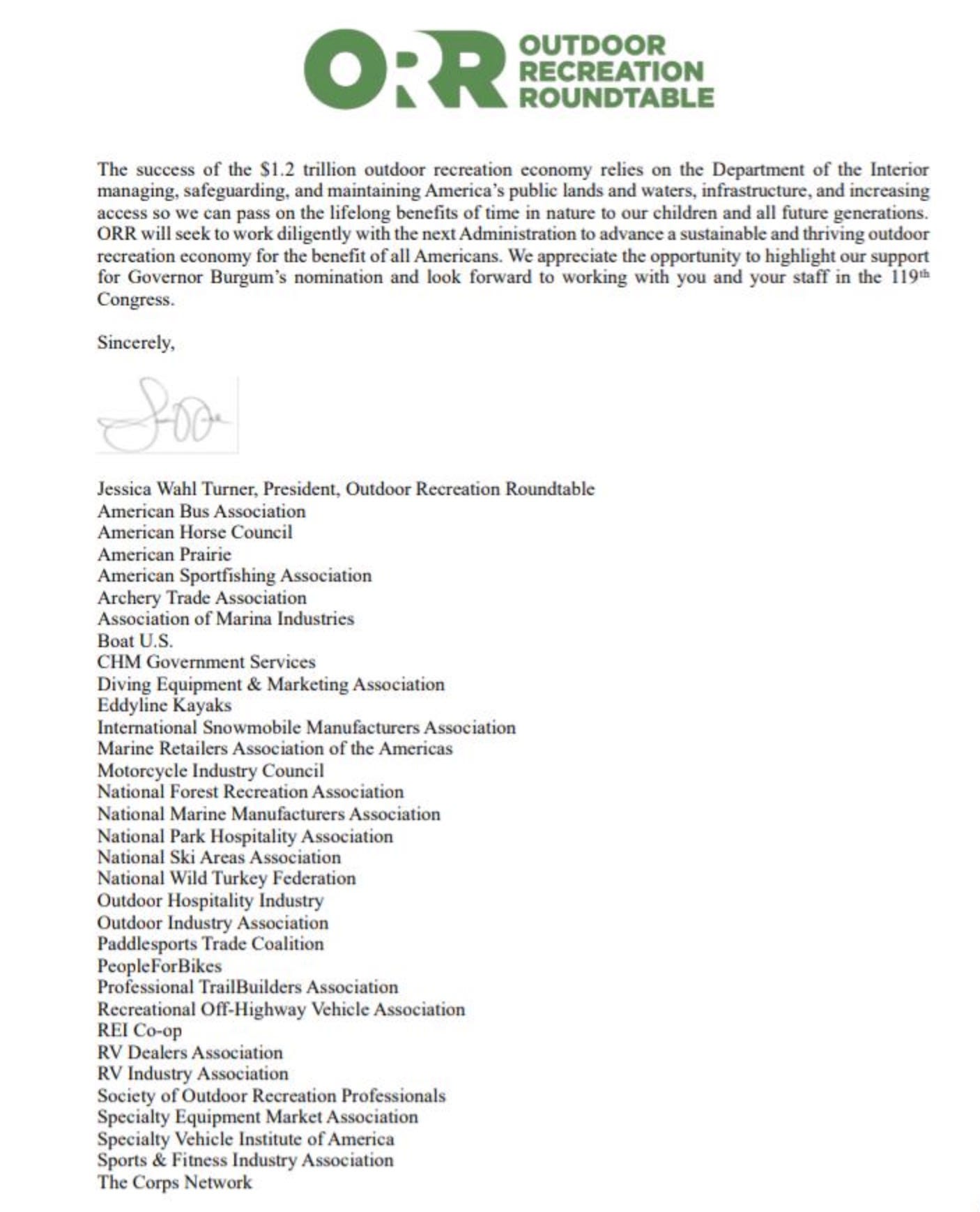
In January 2025, the Outdoor Recreation Roundtable, which includes the Outdoor Industry Association, sent a glowing letter to the Senate Energy and Natural Resources Committee endorsing Burgum. The letter declared that “the success of the $1.2 trillion outdoor recreation economy relies on the Department of the Interior managing, safeguarding, and maintaining America’s public lands and waters.” It then endorsed the man now failing to do exactly that.
The ORR claimed Burgum was “an avid outdoorsman who hunts, snowmobiles, sails, skis, rides horses” with “a long-time admiration of Teddy Roosevelt.” Roosevelt, whose legacy is now undermined: Burgum is presiding over cuts of 53 percent to resource stewardship funds and 55 percent to the NPS construction and major maintenance budget, leaving the agency with less than $50 million for repairs nationwide. Roosevelt is spinning in his grave fast enough to power the grid.
The stated rationale for this endorsement was to “have a seat at the table and continue outdoor recreation advocacy,” but real outcomes matter.
Having a seat at the table in Washington matters only if the people across the table fear the consequences of your departure. Burgum's endorsement exposed that the outdoor industry lacks political leverage; it is tolerated and ignored.
The oil and gas industry does not write letters expressing hope that an Interior Secretary nominee will be “supportive.” It writes checks, funds campaigns, deploys armies of lobbyists, and then watches its preferred candidates gut environmental regulations on live television. It does not ask for a seat at the table. It owns the table. It built the building where the table is. When oil and gas want something from the Department of the Interior, it gets it, and this budget proves that point with excruciating clarity.
Meanwhile, the $1.2 trillion outdoor recreation economy, an industry larger than oil and gas extraction, arrived at the most consequential Interior Secretary nomination in a generation and said: We are hopeful. The administration saw the letter, filed it under “handled,” then proposed cutting wildlife management at the Bureau of Land Management by 70 percent, slashing the Historic Preservation Fund, and floating the idea of offloading park units to the states, knowing there was no real cost.
That’s not politics. That’s a nature documentary. The outdoor industry is the bird that lands on the back of the hippopotamus and picks bugs off its hide. The hippopotamus does not care about the bird.
The cold math: the administration has already spent $17 million of taxpayer money on a fountain across from the White House, a vanity expenditure that no amount of outdoor industry advocacy could stop, slow, or even publicly question until the damage was done. If a $1.2 trillion economic sector can’t prevent a decorative fountain from being installed while its core infrastructure gets defunded, it needs to have a very honest conversation about what its political leverage actually is and isn’t.
Currently, the industry’s leverage appears limited.
That’s not because outdoor recreation voters don’t exist. They do, and they are everywhere, in red states and blue states, in rural counties and urban zip codes. Public lands poll through the roof across party lines. The problem is that the industry has historically preferred branding to organizing, vibes to votes, and press releases to political consequence. It is very good at making fleece vests and very bad at making politicians nervous.
Endorsing Burgum did not buy or build goodwill. It diminished the industry’s credibility at a crucial moment. Supporting a “Brands for Public Lands” coalition while endorsing someone who reduces protections creates a contradiction that is noticed in committee rooms.
To REI’s credit, CEO Mary Beth Laughton had the integrity to stand up, look into a camera, and say the quiet part out loud. “Let me be clear, signing that letter was a mistake. I’m here today to apologize to our members and to take full accountability.” It took a few months, but the apology landed, and REI backed it up by joining the Conservation Alliance’s new Brands for Public Lands coalition. Good. That’s what accountability looks like. Bloomberg
The Outdoor Industry Association has not apologized. Not a word.
That silence is its own statement, one that members, customers, and stakeholders of the outdoor industry should notice. OIA represents an industry wholly dependent on the health of public lands. Its members sell tents, waders, trail runners, kayaks, and climbing gear—items rendered worthless without places to use them. The organization acknowledged this in its letter: the outdoor recreation economy requires a functional Department of the Interior. Yet fifteen months later, as that department is gutted, OIA still hasn’t found the words.
In the hearing room, Burgum was busy not answering questions. When asked where the extra $8 billion beyond the D.C. maintenance backlog would fund, Burgum answered: “D.C., it’s not just the National Mall. It’s for the greater capital region. That’s a region.” Senators noted that, even including Maryland and Virginia, deferred maintenance amounts to only $4 billion—more than half remains unaccounted for. Burgum said he’d get the information “according to law” but declined to provide a list. Presumably, the list is also efficient.
Senator Angus King called it as he saw it: “This is damage for the buck. This is huge damage to the Park Service for a very minimal return in terms of reduction to the deficit.” He also noted that Burgum didn’t even have visitor data to support the cuts, and the man running the National Park Service couldn’t answer basic questions about the people using it. Ready. Fire. Aim. Then slash the budget.
And the National Park Service, for the record, is the most popular federal agency in America. The outdoor industry’s customer base shows up at those parks by the millions. They buy your gear before they go. They buy your gear when they get back. They buy your gear because those places exist.
While the Senate was busy not getting answers about the $10 billion presidential beautification fund, Burgum’s Interior Department quietly published the final repeal of the Bureau of Land Management’s Public Lands Rule, a 2024 Biden-era rule that put conservation on equal legal footing with drilling, mining, logging, and grazing across 245 million acres of public land. The repeal was effective immediately upon publication in the Federal Register. No drama. Just done.
The rule had one central and reasonable premise: that conservation, protecting watersheds, restoring habitat, and sustaining the ecological systems that make public land usable for anything other than extraction, should count as a legitimate “use” of public land under the BLM’s multiple-use mandate. It allowed public property to be leased for restoration, just as oil companies lease it for drilling. It required science-based decision-making. It was finalized with more than 90% of public commenters supporting it. Ninety percent. That is not a close call.
Burgum’s rationale for repeal: the rule “had the potential to block access to hundreds of thousands of acres of multiple-use land, preventing energy and mineral production, timber management, grazing, and recreation across the West.” He included recreation—remarkable, since the rule protected land for recreation. One in ten westerners gets clean drinking water from BLM lands. That’s a faucet, not an abstraction.
The BLM repeal is not an isolated event. It is one piece of a coordinated campaign: the administration is simultaneously moving to repeal the Roadless Rule, which protects nearly 60 million acres of national forests, restructuring the U.S. Forest Service in ways that eliminate regional offices and shutter research stations, and weakening Clean Water Act protections. It is a comprehensive dismantling, running on multiple tracks at once, designed to move faster than opposition can organize.
The outdoor industry’s business model runs through it all. Not metaphorically. Literally. The trails, the rivers, the forests, the elk habitat, the clean-water fisheries, these are the product. And the nominee that the Outdoor Recreation Roundtable endorsed is systematically delisting them as a management priority, one Federal Register notice at a time, while the industry adjusts its chair.
So here’s the uncomfortable question the outdoor industry needs to sit with: if your political strategy consists of writing supportive letters and hoping for access, and the result is a 40 percent maintenance cut, a 70 percent wildlife management cut, and a $10 billion slush fund for presidential beautification projects, what exactly was the strategy for? From where the rest of us are standing, it looks like the industry traded its credibility for a meeting that never happened, with a secretary who never needed its approval in the first place.
You want a seat at the table? Stop asking for one. Start making it too expensive for politicians to ignore you. Fund campaigns. Mobilize customers. Primary people. Make the outdoor voter a political identity that candidates fear, not a demographic they nod at during photo ops at the trailhead.
What in the what.