
Drying Time
Fresno, October 1986

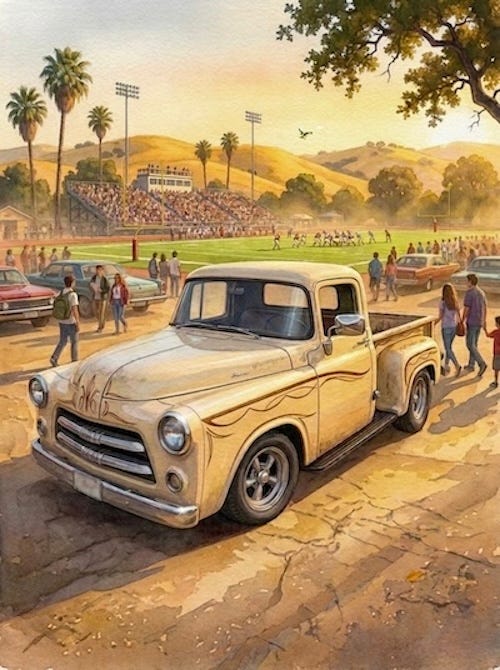
Dedicated to my good friend Ed Sozinho and all the friends he grew up with in and around the Fresno area.
Renata Salazar had decided, somewhere around the third quarter, that she would remember this moment exactly. Not the game or the score. Hoover was losing to Clovis West by two touchdowns, the way they always lost to Clovis West, but the heat still coming off the aluminum bleachers at seven o’clock, the way it pressed up through her jeans even now. The smell of Frito pie, cut grass, and somebody’s dad’s cigarette. The marching band murdering “Walk Like an Egyptian” at halftime. Her mother next to her with a cardigan she wouldn’t need, her father with his arms crossed, pretending he understood the down-and-distance. And David, number 64, somewhere in the scrum on the line, doing the unglamorous work that nobody put on a poster.
He wasn’t the one the girls in front of her were watching. That was Marquez, the quarterback, who would peak this year and spend the rest of his life saying so. David played guard. He blocked. He opened the holes the other boys ran through and got his name called, approximately never, and Renata thought there was something about loving a person whose whole job was to make someone else look good and ask for nothing in return.
She had not told him that. She also told him useful things. Apply to Fresno State as a backup. Take the welding certification even if you think you won’t need it. Write to me, real letters, not just calls. Renata Salazar gave instructions the way other people breathed. It was, her abuelita said, going to make her either a senator or a great deal of trouble. Renata picked a third thing: veterinary medicine at Tufts in Massachusetts, two weeks from now, three thousand miles from the only valley she’d ever stood in. That was the part nobody could give her instructions about.
“Renata.” Her mother nudged her. “Look up.”
An osprey came in low over the south end zone, unhurried, and in its talons, it carried a trout, a whole trout, silver and still wet, hauled up out of the San Joaquin or some canal and flown here, to a football game, like a late-arriving guest. The bird beat once, twice, and settled on the lip of the press box above the home stands.
And then, it began to eat.
Renata watched a strip of trout detach and fall in a lazy arc directly onto the Hoover Booster Club’s reserved section. A man in a foam finger shot to his feet. A woman shrieked. The osprey, unbothered, dropped a second portion, which struck the snack-bar awning with a wet slap.
Renata laughed. She laughed so hard her father turned to stare at her, and her mother laughed so hard she had to grip the rail. It might have been the funniest thing she had ever seen, the dignity of the bird, the indignity of the boosters, a fish arriving from heaven in pieces over Hoover’s fans. She wanted to bottle it. She wanted to tell David. She wanted it to be after the game already.
Hoover lost by twenty-one.
He found her by the fence, his hair wet, a grass stain across his jersey, and he was smiling that slow smile he had, the one that didn’t care about the scoreboard, and she thought, remember this face.
“Did you see the bird?” she said.
“What bird?” She was already laughing again.
His truck was parked under the pepper tree at the far end of the lot, a 1956 cream-colored Dodge lowboy with brown scallops and three-on-the-tree. He’d spent two years restoring it in his dad’s shop with sandpaper, Bondo, and a stubbornness that was the most attractive thing about him. The chrome caught the parking-lot lights. And there, dead center on the rear bumper, fresh, was a sticker that read in block letters, BIG & BEEFY.
“My friend Ed,” David said, “I tried to get it off, but the glue’s too good.” He shrugged. “It’s kind of growing on me.”
“You’re leaving it.”
“I’m leaving it.”
She loved him so much, at that moment, that it frightened her.
They drove west, out past where the lights gave up, the radio low, the windows down, the warm air pouring in. Reagan and Gorbachev had been in Iceland that week, on every front page, talking about ending the world or saving it; nobody could tell which. Somewhere people were terrified of a great many things. None of it reached the grape fields.
He turned off onto a dirt row between the vines, shut off the engine, and the quietness came down like a silent pause. The Thompson Seedless were laid out to dry on long sheets of brown parchment between the rows, acres of them, turning slowly into raisins underneath the open sky, and the smell. The smell was the entire valley distilled, sugar and sun and dust plus something almost like caramel, thick enough to lie down in.
They lay down in it. He’d thrown an air mattress in the truck bed; she’d teased him about it once and never would again. They climbed up and stretched out on their backs, shoulder to shoulder, and watched the last of the twilight bleed off the western edge of everything.
And then the stars.
It happened all at once, the way it does out there, the dark deepening until the Milky Way unrolled across the whole sky, like a river, more stars than a person could hold a thought against. No blinking. No moving points of light moving across the sky within tidy lines. Nothing crossed it at all. The sky was only stars, fixed and ancient and completely still, an unbroken thing that she would not, in all the years to come, ever quite see again, though she wouldn’t know that tonight. Tonight it was simply the sky, the way it had always been, the way she assumed it always would be.
It was cooling now. She felt it on her arms.
He turned and pulled her in, and she let herself be pulled, and they held each other for the warm feeling of it and then for more than that, and they kissed the way they had been kissing all year, seriously, like it mattered, like they were practicing for a life. His hand remained at the small of her back. Hers stayed in his hair. The raisins breathed their aroma all around them, and the truck ticked as the engine cooled and somewhere far off a dog barked and went quiet.
It did not go further. It never had.
She had decided that a long time ago, and he had never once made her defend it, which was, she realized now, looking up past his shoulder at three thousand miles of stars, a kind of love that didn’t get its name called either.
“I’m going to be a vet,” she said to the sky.
“I know.”
“In Massachusetts.”
“I know.”
“And you’re going to stay here and fix trucks and grow grapes with your dad.”
“Somebody’s got to.” He said it lightly, but his arm tightened. “You’re going to be the best one there is. The whole East Coast’s going to find out what the valley already knows.”
She laid her face into his neck.
Two weeks. A fish falling out of the sky onto the booster club. A cream colored truck with a ridiculous sticker that he was going to drive, she suddenly knew, for the rest of his life, long after she was gone, BIG & BEEFY and all. The smell of raisins. This exact and ordinary night that she had decided, in the third quarter, to remember exactly, before she’d had any idea it would be the one worth remembering.
“Hey,” she said.
“Hm.”
“Keep the sticker, promise me.”
He laughed, that she felt more than heard, through his chest, through the mattress, through the steel of the truck he’d rebuilt with his own hands. “That,” he said, “is the first instruction you’ve ever given me I was already planning to follow.”
She let that sit. The raisins breathed. She didn’t look at the sky again, didn’t measure the miles or count the weeks or do any of the arithmetic she was so good at. She just stayed where she was, in the warm dark, with the smell of the whole valley turning to sugar around them, and for once in her life Renata Salazar gave no instructions at all.
That was really good. I went to Clovis High and you took me home for a minute. Great story, great writing. Well done.
I couldn’t put this down. So very good.